---
title: "Run Codync on a remote server"
description: "Run the Codync host on an always-on exe.dev VM and message Claude Code, Codex and Pi as bots from your iPhone, desktop or terminal. No API keys."
url: https://exe-staging.dev/deploy/codync
category: "AI agents"
updated: 2026-11-02
---
# Run Codync on a remote server
Your coding agents as bots you message, on a VM that never sleeps.
- **Software:** Codync (https://www.codync.dev)
- **Source:** https://github.com/leepokai/Codync
- **License:** Apache-2.0
- **Time:** 10 minutes
- **Example VM name:** `my-codync` (yours will differ; on the VM, `hostname` prints it)
- **Machine-readable:** https://exe-staging.dev/deploy/codync/manifest.json
## What you get
- codync-host running as a systemd user service on the VM, back after a reboot
- Claude Code, Codex and Pi using exe.dev's LLM integration, with no API key to paste
- Codync's lead bot on Claude Code, answering `OK` to `codync-host send`
- The host connected to Codync's relay, ready to pair with a phone
- A Git project at `~/project` for bots to work in
Running on the VM:
- **codync-host**: Codync's Rust host, a systemd user service; drives the agents over ACP, port 19222, data in `~/.codync`
- **Node.js 24**: Codync's own copy, for the Claude Code, Codex and Pi adapters, data in `~/.codync/node`
- **Claude Code, Codex and Pi**: preinstalled; connected to exe.dev's LLM integration, data in `~/.claude, ~/.codex, ~/.pi`
- **Your project**, data in `~/project`
How it is reached:
- ssh my-codync.exe.xyz (private): the terminal UI, pairing, and the desktop app's SSH tunnel
- Codync's iPhone app (private): through Codync's end-to-end encrypted relay, after you pair it and sign in to Codync
## Deploy with Shelley
Open https://exe-staging.dev/new?prompt=Set%20up%20Codync%20on%20this%20VM%20by%20following%20the%20exe.dev%20recipe%20at%20https%3A%2F%2Fexe-staging.dev%2Fdeploy%2Fcodync.md%20from%20top%20to%20bottom.%0A%0AThe%20recipe%27s%20example%20VM%20name%20is%20my-codync.%20This%20VM%27s%20name%20is%20the%20output%20of%20%60hostname%60%3A%20use%20it%20wherever%20the%20recipe%20writes%20my-codync.%20Skip%20the%20step%20that%20creates%20the%20VM%3B%20you%20are%20on%20it.%0A%0AYou%20are%20done%20when%20all%20of%20these%20are%20true.%20Check%20each%20one%20yourself%3A%0A-%20codync-host%20running%20as%20a%20systemd%20user%20service%20on%20the%20VM%2C%20back%20after%20a%20reboot%0A-%20Claude%20Code%2C%20Codex%20and%20Pi%20using%20exe.dev%27s%20LLM%20integration%2C%20with%20no%20API%20key%20to%20paste%0A-%20Codync%27s%20lead%20bot%20on%20Claude%20Code%2C%20answering%20%60OK%60%20to%20%60codync-host%20send%60%0A-%20The%20host%20connected%20to%20Codync%27s%20relay%2C%20ready%20to%20pair%20with%20a%20phone%0A-%20A%20Git%20project%20at%20%60~%2Fproject%60%20for%20bots%20to%20work%20in%0A%0ARun%20the%20VM-side%20commands%20in%20%22Set%20up%20the%20VM%22%20only%3B%20skip%20creating%20the%20VM.%0AIf%20%60exeuntu%20configure%60%20reports%20an%20existing%20user%20config%2C%20leave%20it%20alone%2C%0Aand%20leave%20an%20existing%20%60~%2F.pi%2Fagent%2Fexe-dev-llm-integration.json%60%20alone.%0AIf%20%60~%2F.codync%60%20already%20holds%20bots%2C%20ask%20the%20owner%20before%20reinstalling.%0ADon%27t%20run%20%60codync-host%20pair%60%2C%20don%27t%20approve%20access%20requests%2C%20and%20don%27t%0Asign%20in%20to%20any%20Codync%20account%3A%20pairing%20is%20the%20owner%27s%2C%20from%20their%20phone.%0AVerify%20with%20the%20checks%20at%20the%20end%20of%20that%20section%3A%20%60codync-host%20status%60%0Asays%20installed%20and%20running%2C%20%60codync-host%20cloud%60%20says%20%60connected%3A%20true%60%2C%0Aand%20the%20lead%20bot%20answers%20%60OK%60.%20Skip%20the%20later%20sections%20and%20the%20FAQ.%0AFinish%20by%20telling%20the%20owner%20to%20run%20%60ssh%20-t%20%3Cthis%20VM%27s%20name%3E.exe.xyz%0Acodync-host%20tui%60%20to%20meet%20their%20bots%2C%20and%20%60ssh%20-t%20%3Cthis%20VM%27s%0Aname%3E.exe.xyz%20codync-host%20pair%60%20to%20pair%20their%20iPhone%20%28%22Pair%20your%0AiPhone%22%29.%0A%0AFinish%20with%20the%20URLs%20I%20should%20open.%0A to create a VM whose agent, Shelley, follows this recipe. From a terminal:
```sh
curl -fsSL https://exe-staging.dev/deploy/codync/prompt.txt | ssh exe.dev new --prompt=/dev/stdin
```
Or follow the steps below by hand.
[Codync](https://www.codync.dev) turns the coding agents on a computer,
Claude Code, Codex, Pi and about 40 more, into named *bots* you message
like colleagues: from its iPhone app, its desktop app, or a terminal UI.
Each bot has its own agent, folder, approvals and one ongoing chat, and
your phone gets a notification when one is done or needs you. It's an
open-source take on Grok Bot that brings your own agents.
The bots run in `codync-host`, a small Rust service, on the computer
where the agents are. Put it on an exe.dev VM and they keep working while
your laptop sleeps: the VM is always on, its disk keeps every chat, and
your phone reaches it through Codync's encrypted relay with no port to
open. Claude Code, Codex and Pi come preinstalled and use exe.dev's
[LLM integration](/docs/integrations-llm): no API keys on the VM, and
model usage billed to your exe.dev account.
> [!NOTE]
> Codync ships several releases a day. This page was checked with
> codync-host 2.34.2, the release its installer picked on November 2,
> 2026; the host updates itself.
## Set up the VM
On your computer, create a VM and connect. Pick any free name; if you've
already clicked Deploy or have a VM, skip the first command and use its
name:
```bash
ssh exe.dev new --name=my-codync
ssh my-codync.exe.xyz
```
On the VM, connect the agents to the LLM integration. Claude Code and
Codex get a setting each; for Pi, the file holds the answer to the
question it asks the first time it starts, **Use exe.dev LLM
integration**:
```bash
exeuntu configure claude
exeuntu configure codex
mkdir -p ~/.pi/agent
[ -e ~/.pi/agent/exe-dev-llm-integration.json ] || echo '{"version": 1, "useExeIntegration": true}' > ~/.pi/agent/exe-dev-llm-integration.json
```
Still on the VM, install the host with Codync's
[installer](https://github.com/leepokai/Codync/blob/main/packaging/install.sh),
which downloads the release binary into `~/.local/bin` and checks its
SHA-256. The link puts it on the `PATH` of one-off SSH commands too.
Codync then adds its own Node.js, which the Claude Code, Codex and Pi
adapters run on, and saves a copy of the
[ACP agent registry](https://agentclientprotocol.com/registry): without
one, the first bot Codync makes, your lead bot, can't pick Claude Code and
starts on another agent. Last, the service:
```bash
curl -fsSL https://raw.githubusercontent.com/leepokai/Codync/main/packaging/install.sh | sh -s -- --host-only
sudo ln -sf ~/.local/bin/codync-host /usr/local/bin/codync-host
codync-host node
curl -fsSL https://cdn.agentclientprotocol.com/registry/v1/latest/registry.json -o ~/.codync/registry.json
codync-host install
sudo loginctl enable-linger "$USER"
git init ~/project
```
Check it. The host takes a few seconds to start; then it's installed and
running, it's connected to Codync's relay (`connected: true`, in no
account yet), and your lead bot, **Codync**, answers `OK` through Claude
Code:
```bash
sleep 10
codync-host status
codync-host cloud | grep -E '^(connected|account)'
codync-host send --bot Codync --wait "Reply with exactly: OK"
```
## Meet your bots in the terminal
The terminal UI needs no account and works from any SSH client, your
phone's included. On your computer:
```bash
ssh -t my-codync.exe.xyz codync-host tui
```
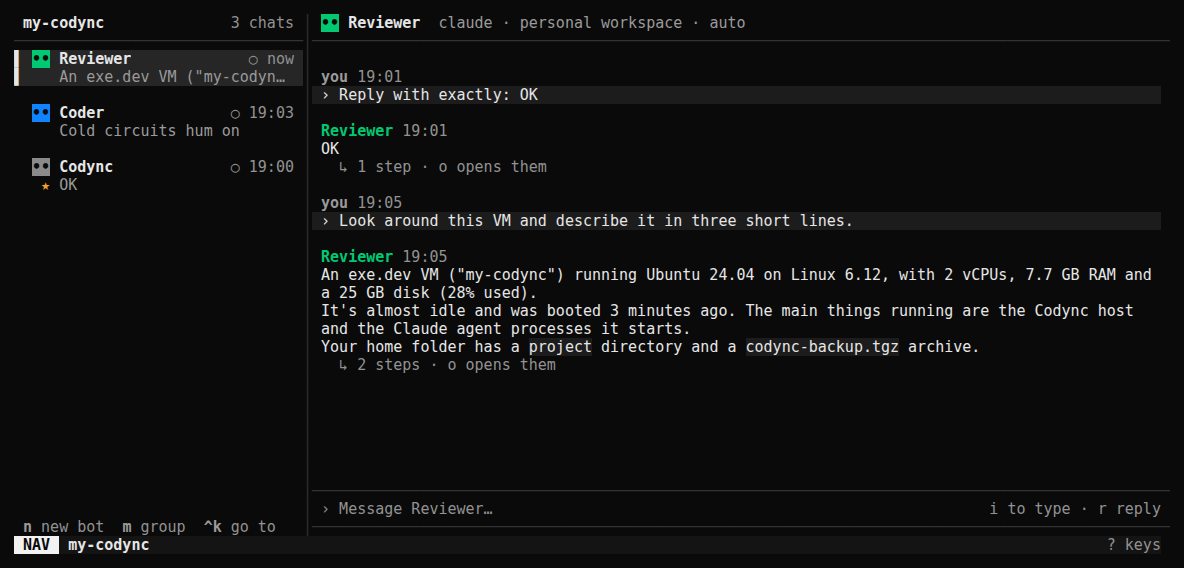
The roster on the left, one chat per bot on the right; each reply hides its tool calls behind "steps".
Press `n` to make a bot and give it a name. It starts on Claude Code in a
folder of its own; press `e` for its settings, where **Agent** switches it
to Codex or Pi and **Workspace → Choose project folder…** points it at
`~/project`. Press `i`, type a task, and `Enter`:
> Write index.html in this folder: a one-page site for a very opinionated cat.
If the agent wants approval, a card appears: `y` allows it once, `a`
always, `n` rejects it. `q` quits the UI; the bots keep going. `?` lists
every key.
Scripts and other agents can message bots too, and wait for the answer:
```bash
ssh my-codync.exe.xyz codync-host send --bot Codync --wait "What's in ~/project?"
```
## Pair your iPhone
Install [Codync from the App Store](https://apps.apple.com/app/codync/id6760984418)
(iOS 26 or later) and sign in with Apple, Google or GitHub. On your
computer, show a pairing code; it lasts 10 minutes:
```bash
ssh -t my-codync.exe.xyz codync-host pair
```
On the phone, scan the QR code, or type the short code printed under it.
The VM isn't in an account yet, so the terminal asks whether to let the
phone in, and both show a 6-digit code: if they match, answer `y` within
90 seconds. The VM joins your Codync account and its bots appear on the
phone, listed under **my-codync**.
The phone reaches the VM through Codync's relay, which passes only
encrypted traffic; nothing on the VM is opened to the internet. Lock the
phone mid-task, and a notification says when the bot is done or wants
approval. To add a second phone later, sign in with the same account,
tap **Ask for access** under **Manage computers**, and approve it on the VM:
```bash
ssh my-codync.exe.xyz codync-host access
ssh my-codync.exe.xyz codync-host access approve 123456
```
Use the 6-digit code the phone shows; `codync-host devices` lists the
devices that can use the VM, and `codync-host devices revoke `
removes one.
## Add it to the desktop app
Codync's desktop app for macOS, Windows and Linux runs the VM's bots next
to your computer's, over SSH with your exe.dev key. It also asks you to
sign in to Codync. Run `ssh my-codync.exe.xyz` once in a terminal first,
so the VM's host key is saved, then open **Settings → Computers**, choose
**Add SSH computer** under **Over SSH**, enter `my-codync.exe.xyz`, and
**Trust and connect**. The host is already installed, so there's nothing
to install. **Add to account** on its card puts the VM in your Codync
account if you haven't paired a phone yet.
## What keeps running
- **Laptop closed, phone locked, app quit:** the bots keep working on the
VM. Messages you send from the iPhone while the VM can't be reached wait,
encrypted, at the relay for up to a day.
- **The VM restarts:** systemd starts the host again and it reconnects to
the relay. Chats and bots are on disk; each bot resumes its agent's
session on its next message.
- **Updates:** the host checks for a new release once a day and installs it
while no bot is working. Releases wait until the iPhone app that goes with
them is in the App Store.
## Make yourself at home
- **Bring your code:** [connect a GitHub repo](/docs/integrations-github)
and clone it with `git clone https://github.int.exe.xyz//.git`,
then make it a bot's workspace. The VM pushes and pulls without a token
or SSH key on it.
- **Preview what it builds:** ask a bot to serve the app on `0.0.0.0:8000`,
then open `https://my-codync.exe.xyz/`. It's private until you
[share it](/docs/sharing).
- **A direct connection:** put the VM on your Tailscale network with
[Tailscale identity federation](/docs/integrations-tailscale-wif), then
pair again: the code lists the Tailscale address first, and a phone on
your tailnet connects directly instead of through the relay. With
Tailscale, `codync-host cloud --disable` takes the VM off the relay
entirely; phones that asked for access through your account then can't
connect, but those paired with a QR code can.
- **Shelley is there too:** exe.dev's own agent, at
`https://my-codync.shelley.exe.xyz/`, can hand work to your bots with
`codync-host send`.
## Back up and restore
Your bots, chats, memory and the VM's Codync identity are in `~/.codync`.
For a copy of the whole VM, run this on your computer (choose a free
backup name):
```bash
ssh exe.dev cp my-codync my-codync-backup
```
Back up just Codync's data
On the VM, stop the host for a consistent copy of its database, archive
`~/.codync` without the downloads it can fetch again, and start it:
```bash
codync-host stop
tar -czf ~/codync-$(date +%F).tgz -C ~ --exclude=.codync/node --exclude=.codync/agents .codync
systemctl --user start codync-host
```
To restore on a VM set up as above, stop the host, unpack the archive in
the home folder, and start it again. `identity.json` in it is the
computer's identity: with it, paired phones see the same computer. Run
`codync-host node` afterwards if `~/.codync/node` is missing.
```bash
codync-host stop
tar -xzf ~/codync-2026-11-02.tgz -C ~
systemctl --user start codync-host
```
## Update
The host updates itself. To check now, or to turn that off:
```bash
codync-host update --check
codync-host update --auto off
```
Rerunning the installer updates it too. Update the agents on the VM with
`sudo exeuntu update claude`, `sudo exeuntu update codex` and
`exeuntu update pi`; the iPhone and desktop apps update from their
stores.
## Troubleshooting
- **`codync-host: command not found` over SSH.** The link in "Set up the
VM" is missing; rerun the `sudo ln -sf` line.
- **The lead bot uses OpenCode, or another agent.** The host started
before it had the agent registry. Press `e` on the bot in the terminal
UI and set **Agent** to **Claude Code**.
- **A bot says the agent couldn't start.** On the VM, `claude -p "Reply
with exactly: OK"`, `codex exec "Reply with exactly: OK"` and `pi -p
"Reply with exactly: OK"` show whether the agents work on their own;
rerun `exeuntu configure claude` or `exeuntu configure codex` if not.
Pi failing with *Cannot call write after a stream was destroyed* is
waiting for its first-run question: create the file from "Set up the VM".
- **An agent Codync can't find.** Agents installed after
`codync-host install` may be missing from the service's `PATH`; run
`codync-host install` again.
- **The phone can't pair.** The code expires after 10 minutes and works
once: run `codync-host pair` again. A phone turned away with someone
else's masked email is signed in to a different Codync account than the
one the VM joined (Apple's Hide My Email and Google count as two).
`codync-host cloud` shows the VM's account and whether the relay is
connected.
- **Logs:** `journalctl --user -u codync-host -f`.
For everything else, see Codync's
[Linux server guide](https://www.codync.dev/docs/linux-servers) and
[remote access docs](https://www.codync.dev/docs/remote-access).
## Frequently asked questions
### Do I need a Codync account?
Not for the VM or the terminal UI: the host runs, and bots answer, without one. Codync's iPhone and desktop apps ask you to sign in, free, with Apple, Google or GitHub. Pairing then puts the VM in that account. The account alone never unlocks the VM: a new device needs a pairing code or your approval on the VM.
### Do I have to open a port?
No. The host connects out to Codync's relay, and the phone reaches it through that, end-to-end encrypted. The terminal UI and the desktop app use SSH. The host listens on port 19222, which exe.dev doesn't expose, and its API answers only callers on the VM itself. exe.dev's [HTTPS proxy](/docs/proxy) isn't involved: the iPhone app can't sign in to exe.dev, so don't point it there.
### Can I use my own Claude or ChatGPT subscription?
Yes; Codync runs whatever the agents on the VM are signed in to. For ChatGPT, the simplest way is to connect it as the OpenAI source of your [LLM integration](/docs/integrations-llm): Codex keeps working as set up here. For Claude, run `claude auth login` on the VM after removing `apiKeyHelper` and `env.ANTHROPIC_BASE_URL` from `~/.claude/settings.json` (keep the `statusLine` Codync added), then start a **New session** in each Claude bot.
### How much does it cost?
Codync is free and Apache-2.0 licensed, and Codync's relay is free for your own computers and devices. You pay for the VM as part of your exe.dev plan, and model usage through the [LLM integration](/docs/integrations-llm) is billed to your exe.dev account ([models and prices](/llm-gateway-models)). Your lead bot has a **Check in** routine that wakes it at 09:00 and 18:00 UTC, which uses models too; pause it in the bot's details (`R` in the terminal UI, then `space`).
### Which agents can a bot use?
Any of the ~40 in the [ACP registry](https://agentclientprotocol.com/registry) that run on Linux. This page sets up Claude Code, Codex and Pi. Others need their own sign-in or key on the VM; OpenCode's free models run out quickly, so [point it at the LLM integration](/deploy/opencode) first.
### Is Android supported?
Not publicly yet: Codync's Android app is in closed testing on Google Play. Until then, use the terminal UI from any SSH app on the phone, or the desktop app on macOS, Windows or Linux.
### What doesn't work on a server?
Remote screen and the bots' `computer` tool need a desktop session, so they stay off. Connectors and saved API keys need an unlocked keyring (Secret Service), which a headless VM doesn't have, so bots start without connectors. Chat, approvals, group chats, routines, memory and notifications all work.
## Related
- [Run Herdr agents on a remote machine](https://exe-staging.dev/deploy/herdr.md): An always-on SSH machine for Herdr, with agents ready and no API keys.
- [Run Paseo on a remote server](https://exe-staging.dev/deploy/paseo.md): One app for your coding agents, on a VM you steer from your phone.
- [Self-host OpenMausBot, the open-source Grok Bot alternative](https://exe-staging.dev/deploy/openmausbot.md): A team of AI bots, each with a computer that isn't your laptop.
- [Run Claude Code on a remote server](https://exe-staging.dev/deploy/claude-code.md): A computer for Claude. A breather for your laptop.
- [Run Codex on a remote server](https://exe-staging.dev/deploy/codex.md): A computer for Codex. An early night for your laptop.
- [Run the Pi coding agent on a remote server](https://exe-staging.dev/deploy/pi.md): An agent that doesn't ask first, on a computer that can take it.